
Singapore’s built environment is entering a new phase of digital transformation. The industry is moving beyond digitising individual processes towards enabling data to move seamlessly between systems, organisations and stages of the built environment.
Developed by the Building and Construction Authority (BCA) and the Infocomm Media Development Authority (IMDA), SGBuildex is a data exchange platform that enables project stakeholders including developers, main contractors, laboratory testers and regulators to share information between connected systems.
SGBuildex is not another construction management application and is not intended to replace every system already in use. It acts as a connective layer, allowing information to be exchanged in a structured and standardised manner instead of being repeatedly exported, reformatted and manually uploaded.
BCA reported S$50.5 billion in preliminary actual construction demand in 2025, with construction output estimated at approximately S$41.7 billion. For 2026, BCA projects construction demand of S$47-53 billion and output of S$43-46 billion. Average annual construction demand of S$39-46 billion is projected for 2027-2030.
2025 Construction Demand
2025 Construction Output
2026 Demand Forecast
Major developments and infrastructure programmes include Changi Airport Terminal 5, the Marina Bay Sands Integrated Resort expansion, New Tengah General & Community Hospital, Downtown Line 2 and Thomson-East Coast Line extensions, public housing, institutional projects and industrial developments.
Construction digitalisation often involves fragmented systems: one organisation may use a Site Management Platform, another a separate inspection or workforce system, while regulators require information in defined formats. Without interoperability, teams repeat the cycle of collecting, exporting, consolidating, reformatting, uploading and verifying information. SGBuildex is designed to simplify this process through a common point for participating systems to exchange structured data. BCA’s 2024 proof of concept involved five contractors and three solution providers, with five datasets standardised for regulatory compliance and project management.
Participants recognised the value of standardisation for interoperability, insights and informed decisions; a single connectivity point could reduce the effort and cost of data submission.


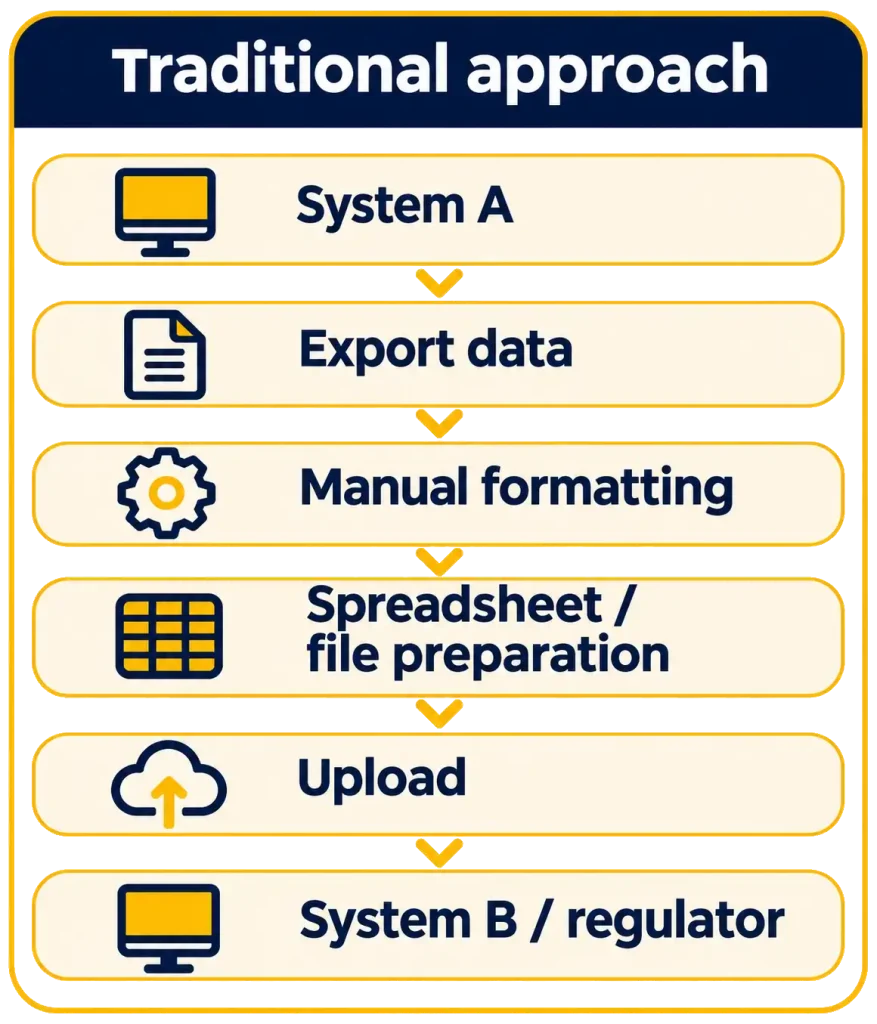
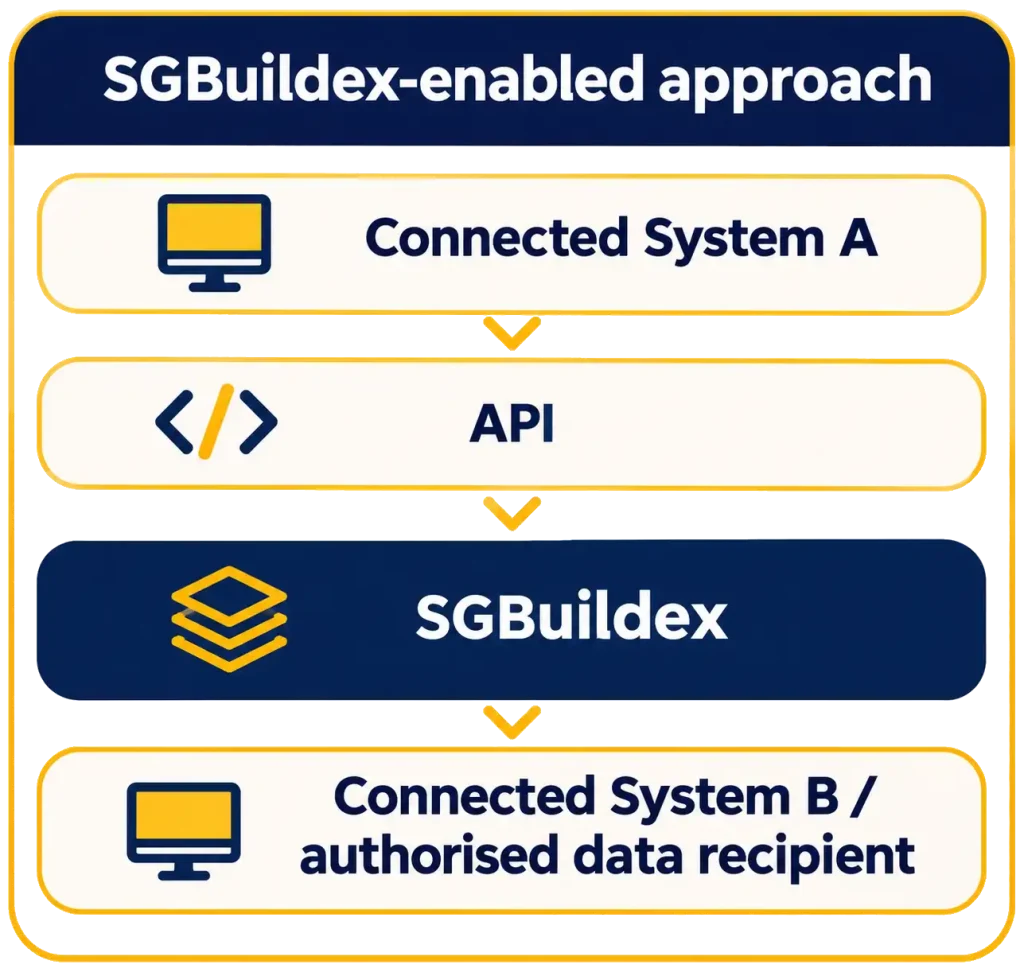
BCA states that participating Site Management Platforms must follow the relevant BCA Site Management Data Standards and be configured according to SGBuildex API standards. Connectivity therefore depends on both technical integration and standardised information.
A significant development is SGBuildex’s role in the revised Construction Productivity Data (CPD) submission process. BCA stated that, effective 1 May 2026, builders of applicable projects applying for a Permit to Commence Work are required to submit CPD through a Biometric Authentication System (BAS) integrated with the data exchange platform. The new workflow uses a single data schema for all project types. Monthly CPD can be submitted automatically and directly to BCA through a BAS connected to SGBuildex via an API. The process also covers builders with new and ongoing projects, including offsite fabricators involved in precast, structural steel and prefabricated mechanical, electrical and plumbing works.
Builders manually collated monthly onsite and offsite CPD in Excel templates and uploaded the information to the Electronic Productivity Submission System (ePSS).
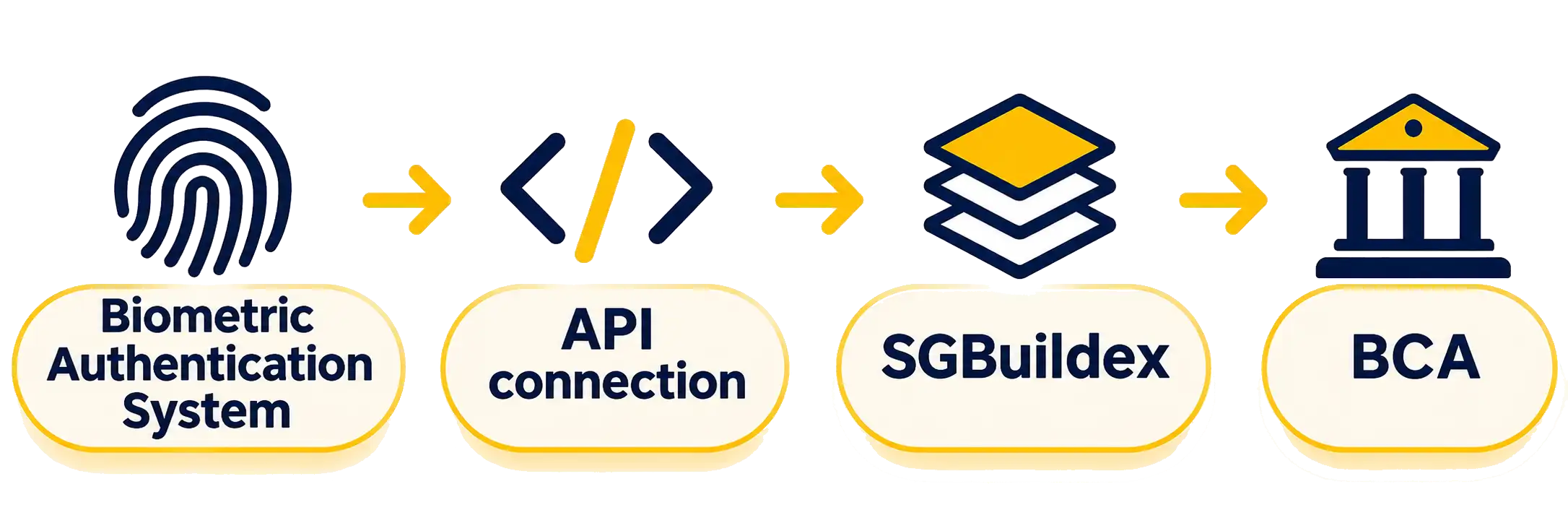
Structured monthly information is transmitted automatically.
The change should be treated as more than another compliance deadline. It signals a move from manual data preparation towards automated transmission of structured information.
Contractors should assess three areas:
Is the required information captured digitally, accurately and consistently?
Can existing platforms connect through the required APIs and comply with relevant data standards?
Can the organisation reduce spreadsheet dependency, manual collation and duplicated effort?
Technology implementation is only one part of the transition. Data quality and process discipline are equally important.
CPD is collected for regulatory and productivity measurement. However, the same connected-data principle can support wider operational insight when relevant datasets are structured and analysed.
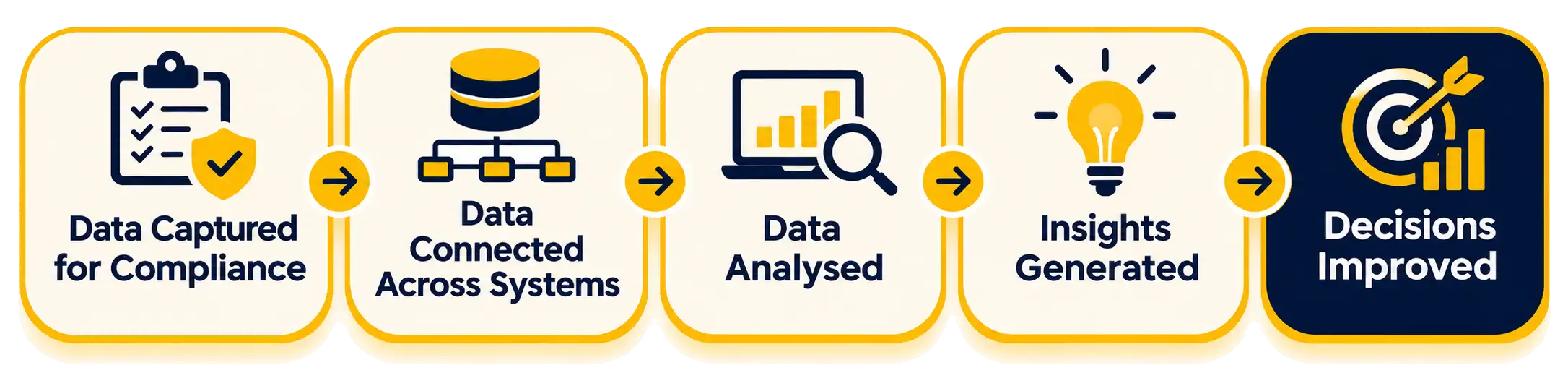
Connecting systems does not automatically make their information compatible. Different definitions, formats and identifiers can prevent meaningful exchange. BCA’s Site Management Data Standards address structured exchange across systems and formats. Standardised data is easier to exchange, validate, compare, analyse, benchmark and use in automated processes. Interoperability requires more than APIs; it requires common meaning.
SGBuildex supports Singapore’s broader built-environment transformation agenda. BCA describes Integrated Digital Delivery (IDD) as a holistic approach connecting stakeholders from design and fabrication through construction and asset management.
BCA reported IDD adoption in new developments rising from 58% in 2023 to 67% in 2024, while Design for Manufacturing and Assembly (DfMA) uptake rose from 61% to 68%. This wider movement encompasses digital delivery, industrialised construction, sustainability, productivity, data and asset performance.
At NGT, we see SGBuildex as more than a mechanism for moving data between systems. It is part of the foundation for a connected built environment. Automation is the immediate business case; operational intelligence is the larger opportunity. Information captured for compliance should also help organisations improve how they operate.
A project becomes an operating asset, but construction and operations information can remain disconnected. Construction generates drawings, specifications, BIM information, inspection and testing results, defect records, asset data, commissioning records and handover documents. Facility teams need asset registers, maintenance information, inspection schedules, equipment history, warranties, compliance and service records, and contractor details. The opportunity is lifecycle continuity: information captured while an asset is designed and built should remain useful after handover. A building should not lose its digital memory. When equipment fails, facility teams should be able to access its model, installer, commissioning date, warranty, previous failures and maintenance history without recreating the record.
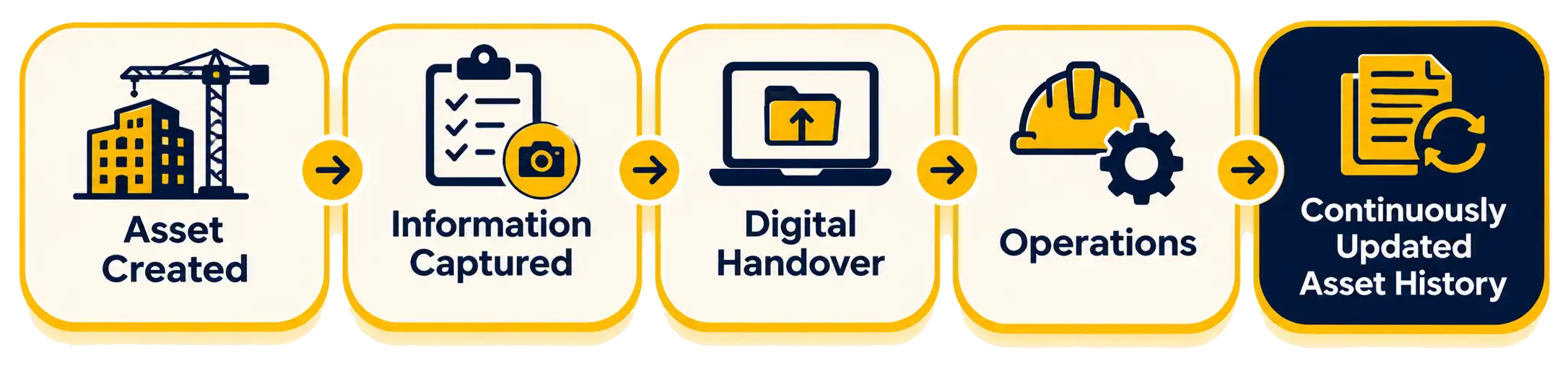
AI can analyse information, identify patterns, generate summaries and support decisions—but only with relevant, reliable data. Identifying assets with repeated maintenance issues requires asset and work-order history; finding recurring defects requires structured defect records; understanding productivity challenges requires reliable workforce and project data.The future is not simply AI + construction. It is connected data + AI + domain expertise + human decision-making. SGBuildex contributes to the connected-data layer; organisations must make the exchanged information useful.
Connected data creates value through efficiency (less repetitive preparation), accuracy (less manual transcription), visibility (more accessible information) and intelligence (analytics, benchmarking and AI). BCA’s SGBuildex proof of concept identified the value of standardised data for interoperability, exchange and informed decision-making.
Digital transformation should reduce complexity, not add another layer. An inspection should inform corrective
action; a defect should become an actionable workflow; a closed work order should contribute to asset history; and an asset record should evolve into an operational dataset. The objective is a connected flow across people, projects, inspections, safety, assets and maintenance.
Information on Site Management Platforms, digitalised site data, data exchange and Whole-of- Government Virtual Inspections. BCA — Ops Tech Enabled Inspections
Source for 2025 construction demand and output, 2026 forecasts, and 2027–2030 annual demand projections. BCA — 2026 Construction Demand Outlook
Reference for standardised exchange, lifecycle information and data-driven collaboration. BCA — Value Chain Collaboration & Data-Driven Decision Making
Technical reference for structured data exchange, the SGBuildex proof of concept, standardisation, APIs and interoperability. BCA — Site Management Data Standards
Explanation of IDD and its role in connecting stakeholders across design, fabrication, construction and asset management. BCA — Integrated Digital Delivery
Source for 2023–2024 IDD and DfMA adoption figures and green-building progress. BCA — Built Environment Sector Transformation Progress
Discover how NewGene Technologies helps construction and facility teams streamline workflows, ensure compliance