
Construction remains one of Singapore’s most hazardous industries. Despite significant regulatory progress under the WSH Act, construction sites account for a disproportionate share of serious workplace accidents each year.
The causes are well understood: high-risk activities, multi-trade coordination, time pressure, subcontractor management complexity, and inconsistent safety culture across workers and supervisors.
What has changed is our ability to address those causes systematically — using digital safety technology that was not available a decade ago.
Here’s how construction companies are using digital safety systems to measurably reduce accidents — and what those systems must do to make a real difference.
Why Construction Accidents Happen: The Root Causes
Most construction site accidents share a common thread. They were preventable. Not in hindsight — in advance. The information and controls that could have stopped them existed. They just weren’t applied consistently.
The most common root causes:
- High-risk work started without proper permit authorisation
- Safety checklists signed off without the checks actually being done
- Workers not inducted for the specific hazard they encountered
- Subcontractors operating without adequate supervision
- Near-misses not reported — and therefore not acted on
- Corrective actions identified in inspections but never followed up
- No real-time visibility for supervisors — problems escalate before anyone can intervene
- Expired certifications — workers assigned to tasks they’re not qualified for
In almost every case, the failure was systemic — not individual. A better system would have caught it.
How Digital Safety Systems Change the Equation
A digital safety management system replaces the inconsistent, paper-dependent, memory-reliant safety processes most construction sites still run — with a structured, automated, evidence-backed workflow.
Here is what that means in practice:
1. Electronic Permit to Work (ePTW)
- No high-risk work can begin without an approved digital permit
- Approval chains are enforced — the system will not issue a permit until all required sign-offs are completed
- Permits are visible to supervisors in real time — active, approved, expired, closed
- Workers cannot bypass the system
2. Digital Toolbox Meetings
- Attendance is captured digitally — no signing the register for absent workers
- Meeting content and safety topic are logged — MOM can verify what was covered
- Records are immediately available — no paper to locate under audit pressure
3. Incident and Near-Miss Reporting
- Workers report incidents and near-misses on their phone — immediately, from site
- Photos uploaded at point of incident — no reconstruction from memory
- Root cause investigation workflow automatically initiated
- Corrective actions assigned to named individuals with deadlines
4. Inspection and Audit Management
- Scheduled and ad-hoc inspections logged on mobile
- Non-conformances documented with photos and corrective action required
- Outstanding actions tracked to closure — nothing is forgotten
- Inspection history available for every site, every month
5. Competency and Certification Tracking
- Every worker’s certifications logged with expiry dates
- Automatic alerts when certifications are approaching expiry
- Workers with expired certifications cannot be assigned to restricted tasks
- Subcontractor worker compliance tracked alongside direct employees
6. Real-Time Safety Dashboard
- Supervisors see active permits, open non-conformances, and outstanding corrective actions in real time
- Management sees site safety performance across all projects simultaneously
- MOM inspectors see a system that is clearly under control — not a pile of folders
The Impact: What Digital Safety Systems Deliver
Companies that implement proper digital safety management systems typically see:
- Reduction in near-miss events — because systematic reporting catches hazardous conditions before they cause harm
- Faster incident response — supervisors notified instantly; investigations begin immediately
- Better corrective action completion — tracked to closure rather than forgotten
- Higher audit confidence — records available instantly, in full, on any device
- Stronger subcontractor compliance — subcontractors are held to the same digital standard as direct employees
- Reduced MOM enforcement action — compliant systems produce compliant outcomes
eSAFE: Built for Singapore Construction Safety
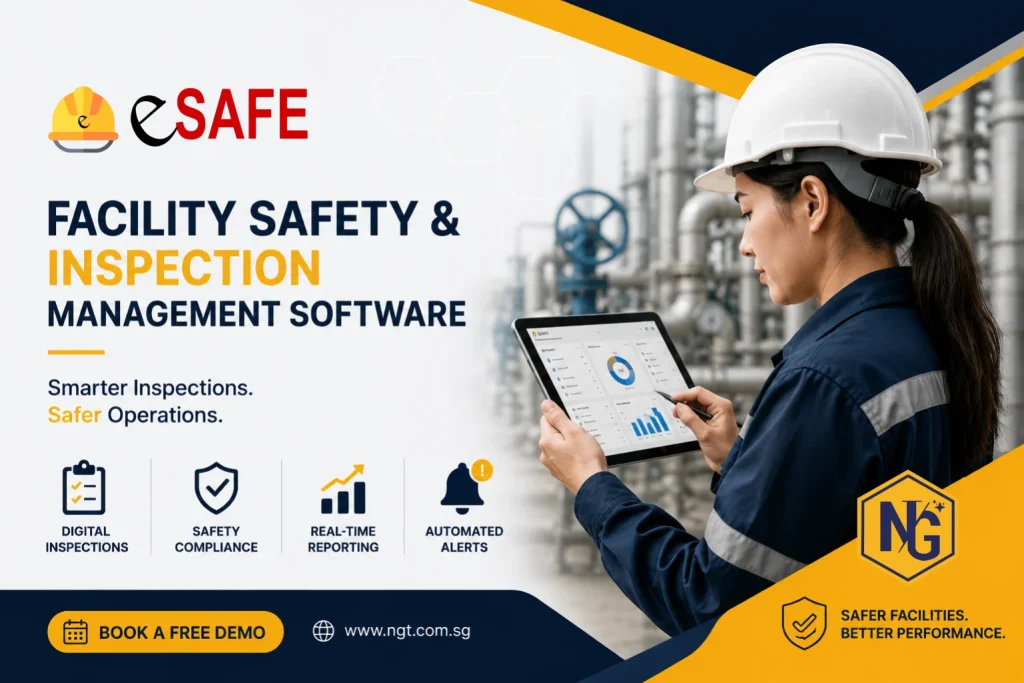
eSAFE by New Gene Technologies is a digital safety management platform purpose-built for Singapore’s construction industry and WSH Act environment.
Key features:
- ePTW (Electronic Permit to Work) — fully digital, offline-capable, with enforced approval chains
- Toolbox meeting management — digital attendance and content logging on mobile
- Incident and near-miss reporting — photo-enabled, MOM-aligned, from any device
- Safety inspections and audits — customisable checklists with non-conformance tracking
- Corrective action management — assigned, tracked, and closed with evidence
- Training and competency records — expiry alerts, automatic task eligibility control
- Subcontractor safety management — full compliance visibility for all parties on site
- Real-time safety dashboard — site-wide and portfolio-wide visibility for management
Trusted by: Obayashi Corporation, Wee Hur Construction, Soil Build Group, Chiu Teng Construction, Expand Construction — on Singapore government projects including MOE schools, MHA facilities, and LTA infrastructure.
PSG Grant eligible — up to 50% funding for Singapore-registered companies.
Practical Steps to Get Started
If your site still runs on paper safety forms, here is a practical pathway:
Step 1: Audit your current system
- Where are your biggest compliance gaps right now?
- What would MOM find if they arrived on site today?
- Which processes rely most heavily on individual memory or paper records?
Step 2: Define your priority outcomes
- Is your biggest risk in PTW management, incident reporting, or inspection records?
- Which team members need to adopt the system first?
Step 3: Choose a WSH Act-aligned platform
- Ensure compliance templates are built in — not something you have to configure yourself
- Confirm offline capability for your specific site conditions
- Check PSG Grant eligibility to reduce your investment
Step 4: Implement with proper onboarding
- Train supervisors and safety officers first
- Introduce the system to workers on site with clear instructions
- Set adoption targets — 70% within the first month is achievable
Conclusion
Reducing construction site accidents is not about working harder on safety. It is about building better systems. A digital safety management platform eliminates the inconsistencies, gaps, and paper-trail failures that allow preventable accidents to happen.
eSAFE by New Gene Technologies is that platform — built for Singapore, trusted by the country’s leading contractors, and PSG Grant funded.
Book a free demo today and see how it works on your site.